
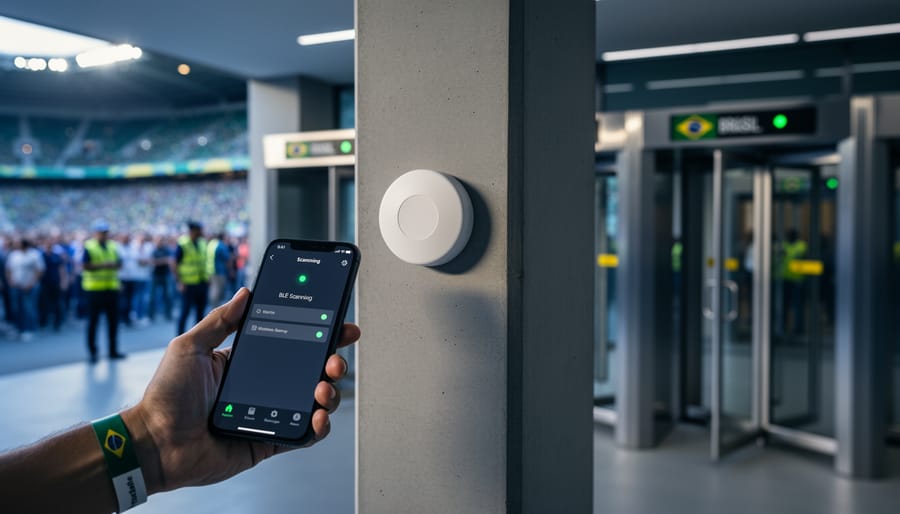
Deploy BLE beacons at physical venue boundaries to create precise geofencing perimeters that verify player locations in real-time, ensuring compliance with Brazil’s strict territorial betting restrictions. bwin bet operators and similar platforms must demonstrate that players are physically present in authorized zones before accepting wagers, making beacon technology essential for legal operations.
Configure beacon transmission intervals between 100-500 milliseconds to balance battery life with location accuracy, using UUID filtering to distinguish between different venue zones. This approach lets you create multi-layered compliance boundaries—entrance zones, active betting areas, and restricted sections—all monitored through a single system that logs player movements for regulatory audits.
Integrate beacon data with your existing betting platform using standard APIs that cross-reference device MAC addresses against user accounts, automatically blocking transactions when players move outside authorized perimeters. The system should include fallback verification using GPS coordinates to prevent circumvention attempts while maintaining sub-meter accuracy that traditional GPS cannot achieve indoors.
Brazilian regulations demand tamper-proof location verification that BLE beacons uniquely provide through their short-range signals and physical deployment requirements. Unlike GPS spoofing, beacon signals require actual physical presence, making them the gold standard for compliance officers reviewing location verification methods. This technology represents one of the most practical IoT applications in regulated industries today.
Understanding both the regulatory landscape and technical implementation transforms beacon geofencing from a compliance burden into a competitive advantage. Operators who master this technology gain faster licensing approvals, reduced regulatory scrutiny, and the ability to expand into new authorized territories with confidence.
Why Brazilian Betting Laws Demand Precise Location Tracking
The Geographic Restrictions You Need to Know
Understanding Brazil’s betting geography is essential before deploying your BLE beacon system. Brazilian betting regulations operate on a nuanced federal framework with specific location-based restrictions that your geofencing solution must enforce.
At the federal level, online sports betting became legal in December 2018, but there’s a crucial distinction: physical betting is permitted only in licensed establishments, while online betting can occur anywhere within Brazilian territory. However, certain locations are universally off-limits regardless of format. These restricted zones include areas within 500 meters of schools, universities, and religious institutions during specific hours. Your beacon network needs to identify and block betting activities in these sensitive areas.
State-level variations add complexity to your implementation. While federal law provides the baseline, individual states maintain authority to impose additional restrictions. Some municipalities have designated specific commercial zones where betting kiosks can operate, while others have broader prohibitions. This means your geofencing system needs configurable parameters that adapt to local regulations.
For DIY implementers and operators, the practical approach involves creating layered geofence boundaries. Primary geofences mark where betting is explicitly allowed, like licensed shops or designated zones. Secondary geofences identify prohibited areas requiring active blocking. A third layer monitors boundary zones where users transition between permitted and restricted spaces.
Testing your beacon placement becomes a community-focused project. Collaborate with local operators and regulatory advisors to map accurate boundaries, ensuring your system respects both federal guidelines and regional variations while maintaining seamless user experiences.
What Happens When Compliance Fails
When compliance systems fail in Brazilian betting operations, the consequences can be severe and far-reaching. The Brazilian gaming authority SECAP (Secretaria de Prêmios e Apostas) takes location verification seriously, imposing hefty fines that can reach millions of reais for operators who allow bets from unauthorized locations. These aren’t just warnings – regulators actively monitor for violations.
Beyond financial penalties, operators risk losing their operating licenses entirely. Given the competitive nature of Brazil’s newly regulated betting market, license revocation essentially means business closure. Legal liability extends to company executives and technical teams who knowingly deploy inadequate verification systems.
For DIY implementers and smaller operators, failed compliance can mean being locked out of payment processors and banking services. Brazilian financial institutions must comply with gaming regulations, so they’ll quickly terminate relationships with non-compliant operators.
The reputational damage compounds these issues. News of compliance failures spreads quickly through industry networks and community forums, making it difficult to rebuild credibility. Players also lose trust when they discover operators aren’t following legal requirements.
This makes getting your BLE beacon geofencing implementation right from the start absolutely critical. Testing thoroughly, maintaining detailed logs of location checks, and regularly auditing your system aren’t optional – they’re essential protections for your business and your community of users.
BLE Beacons Explained: Your Indoor GPS Alternative
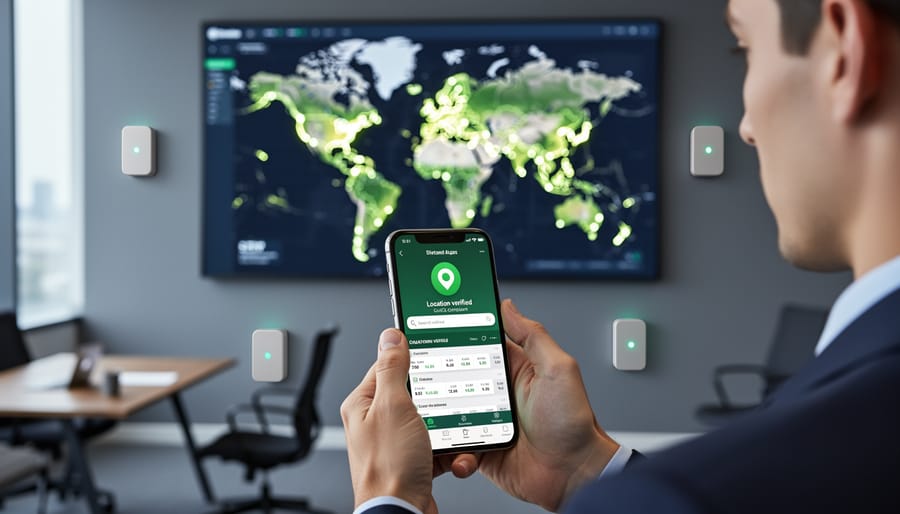
How BLE Beacons Communicate With Smartphones
Understanding how BLE beacons talk to smartphones is simpler than you might think, and it’s the foundation of effective geofencing for betting compliance in Brazil. Let’s break down the communication process step by step.
First, beacon broadcasting happens continuously. A BLE sensor beacon sends out small radio signals at regular intervals, typically every 100 milliseconds to a few seconds. These signals contain a unique identifier and sometimes additional data like transmit power. Think of it like a lighthouse constantly flashing its signal, not waiting for ships to request it.
Next comes smartphone detection. When a betting app is running on a user’s phone with Bluetooth enabled, it passively listens for these beacon signals. The app scans for specific beacon identifiers that match authorized Brazilian locations. This happens in the background without draining battery life, thanks to BLE’s energy-efficient design.
Proximity estimation is where things get interesting. The smartphone measures the signal strength (RSSI) from the beacon to estimate distance. Stronger signals mean you’re closer, weaker ones mean you’re farther away. While not GPS-precise, this method reliably determines if someone is inside or outside a defined boundary, typically accurate within 1-5 meters.
Finally, triggering compliance checks occurs when the app determines proximity. If the user is within the permitted zone, betting functions activate. Step outside that boundary, and the app automatically restricts access, ensuring regulatory compliance without requiring manual verification.
Why BLE Beats GPS for Betting Compliance
When implementing location verification for betting compliance, you might instinctively reach for GPS. But here’s the reality: GPS struggles indoors, and that’s precisely where most betting happens. BLE beacons shine in these challenging environments, making them the superior choice for Brazilian operators.
Think about a typical betting scenario. Someone places a wager from their apartment, a shopping mall, or a busy office building. GPS signals weaken or disappear entirely in these spaces, often requiring 30-60 seconds to get a fix with accuracy ranging from 5-30 meters. BLE beacons, however, provide instant location confirmation with 1-3 meter accuracy, even in concrete structures where GPS completely fails.
Power consumption tells another compelling story. GPS constantly queries satellites, draining device batteries and requiring continuous processing power. BLE beacons operate passively, only transmitting brief signals that smartphones detect with minimal battery impact. For users, this means compliance checks won’t noticeably affect their device performance.
Cost-effectiveness seals the deal. While GPS comes built into smartphones, creating reliable geofences requires expensive server infrastructure for constant position monitoring. A single BLE beacon costs between $10-30 and covers up to 100 meters, with batteries lasting 1-3 years. For operators managing multiple authorized zones, this translates to significant savings.
The reliability factor cannot be overstated. GPS accuracy varies with weather, satellite visibility, and urban canyon effects. BLE beacons deliver consistent performance regardless of external conditions, providing the dependable verification that compliance demands.
Building Your BLE Beacon Geofencing System: A Practical Approach
Hardware Selection: Choosing the Right Beacons
Selecting the right beacons for your Brazilian betting compliance project requires balancing technical performance with practical deployment needs. Let’s break down what matters most for creating a reliable geofencing solution.
For indoor betting locations, standard BLE beacons with a 10-30 meter range work perfectly. These compact devices easily mount on walls or ceilings and provide accurate proximity detection. Look for beacons supporting iBeacon or Eddystone protocols, which integrate seamlessly with most Bluetooth modules and smartphone applications.
Battery life is crucial since frequent replacements increase maintenance costs. Choose beacons offering 1-3 year battery life under typical broadcasting intervals of 100-300 milliseconds. Some advanced models include replaceable coin-cell batteries, making maintenance straightforward for your team.
Weatherproofing becomes essential for outdoor installations or locations with high humidity. Select beacons with IP65 or higher ratings to protect against dust and water exposure. This proves particularly important in Brazil’s diverse climate conditions, from tropical coastal areas to more temperate regions.
Consider beacon density based on your venue size. Smaller betting shops might need only 2-3 beacons, while larger establishments require strategic placement every 15-20 meters to ensure continuous coverage without dead zones.
Budget-friendly options exist from manufacturers like Estimote, Kontakt.io, and RadBeacon, typically costing between $15-40 per unit. Starting with a small pilot deployment helps test configuration before scaling up, reducing both risk and initial investment while building your team’s expertise.
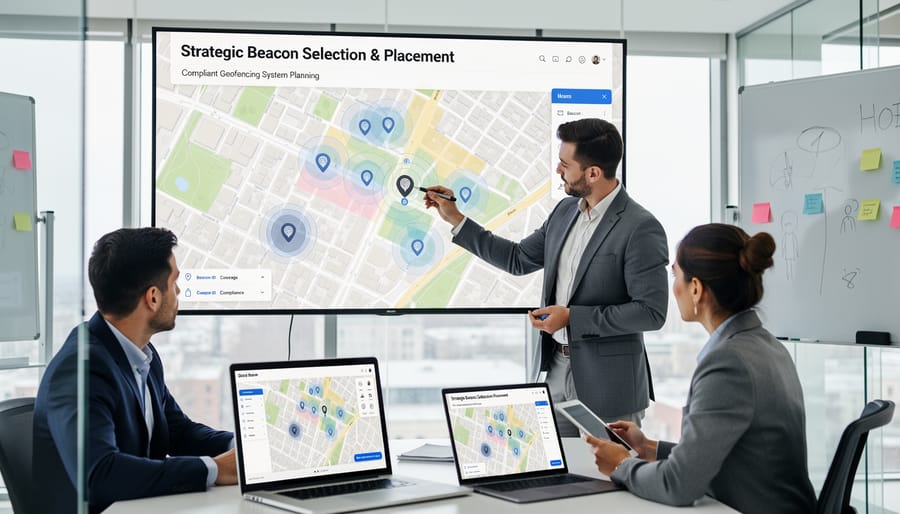
Strategic Beacon Placement for Compliance Zones
Getting your beacon placement right is where theory meets reality in compliance geofencing. Think of beacons as your digital sentries—they need strategic positioning to create reliable compliance zones that satisfy Brazilian betting regulations while being practical to maintain.
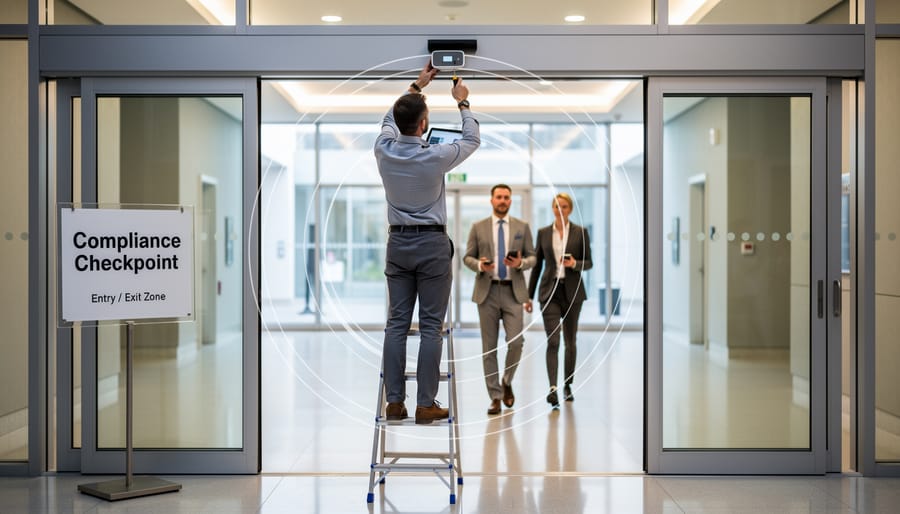
Start at venue entrances, the most critical checkpoint. Mount beacons at eye level or slightly above (around 2-2.5 meters) on both sides of main doorways. This dual-beacon approach creates a stronger signal corridor that’s harder to miss. For wider entrances, consider a three-beacon configuration to eliminate dead zones. Remember, metal doors and electronic security systems can interfere with signals, so test thoroughly before finalizing positions.
Boundary marking requires overlapping coverage zones. Space beacons 5-8 meters apart along restricted perimeters, adjusting for obstacles like walls or equipment. The overlap creates redundancy—if someone’s phone momentarily loses connection with one beacon, another picks up the signal immediately. This prevents false compliance failures that frustrate legitimate users.
For multi-level venues, deploy beacons on each floor near stairwells and elevators. Vertical signal bleed between floors is common, so adjust transmission power carefully to avoid confusion about which level users occupy.
Pro tip from the DIY community: create a simple floor plan marking each beacon’s position and identifier. This documentation becomes invaluable when troubleshooting or scaling your deployment. Test walking paths at different speeds with various devices—older smartphones may have less sensitive Bluetooth receivers requiring tighter beacon spacing.
Budget-conscious operators often succeed with a phased rollout, starting with critical zones and expanding based on actual user movement patterns gathered during initial deployment.
Software Integration: Connecting Beacons to Your Betting App
Connecting your betting app to BLE beacons requires understanding a few essential components that work together to create a reliable geofencing system. Let’s walk through the integration process in practical terms that both beginners and experienced developers can follow.
Start by selecting a beacon SDK compatible with your mobile platform. Popular options include AltBeacon for Android and Core Location for iOS, both offering robust proximity detection capabilities. These SDKs handle the heavy lifting of bluetooth communication, letting you focus on compliance logic. Many beacon manufacturers also provide their own SDKs with additional features like cloud management and analytics dashboards.
The integration process begins with integrating BLE beacons into your mobile app’s codebase. Request necessary Bluetooth permissions from users, explaining clearly why location verification is required for regulatory compliance. Brazilian users appreciate transparency about data usage, so include straightforward explanations in your permission requests.
Proximity detection algorithms determine when users enter or exit authorized zones. Most SDKs categorize distance into immediate, near, and far ranges based on RSSI signal strength. For betting compliance, you’ll typically trigger actions when users enter the immediate or near range, ensuring they’re genuinely within permitted areas. Configure your thresholds conservatively to avoid false positives from signal fluctuations.
Build compliance workflows that activate automatically when zone transitions occur. When a user enters an authorized zone, enable betting features and log the event with timestamps and beacon identifiers. Upon exit, gracefully disable betting functionality while maintaining user experience. Consider implementing a brief grace period to handle temporary signal loss from obstacles or interference.
Test extensively in real-world conditions with various devices and environmental scenarios. Community forums and DIY IoT groups often share valuable troubleshooting tips specific to beacon implementations, helping you refine your system before deployment.
Real-World Implementation: What Works and What Doesn’t
Common Pitfalls and How to Avoid Them
Implementing BLE beacon geofencing for betting compliance comes with challenges, but understanding these pitfalls helps you build a more reliable system from the start.
Signal interference ranks among the most common issues. Bluetooth signals struggle with concrete walls, metal structures, and crowded Wi-Fi environments. To minimize this, conduct thorough site surveys before deployment and position beacons strategically away from interference sources. Consider using multiple beacons per zone to create overlapping coverage areas that compensate for signal dead spots.
Battery management becomes critical when deploying dozens of beacons across multiple locations. Most BLE beacons run for 1-2 years on coin cell batteries, but improper configuration can drain them in months. Set appropriate advertising intervals, typically 100-300 milliseconds for geofencing applications. Create a maintenance schedule with battery monitoring alerts, and keep spare beacons on hand for quick replacements. Some operators prefer beacons with replaceable batteries for easier maintenance.
False positives and negatives can undermine compliance efforts. A user standing just outside the permitted zone might register as inside, or vice versa. Combat this by implementing dwell time requirements, where users must remain in range for 5-10 seconds before triggering authorization. Use RSSI (signal strength) filtering to establish confidence zones, and combine beacon data with other verification methods like GPS for added accuracy.
Privacy concerns deserve serious attention in any location-based system. Be transparent about data collection practices and store only necessary information. Implement data minimization principles by processing location verification locally on devices when possible, rather than continuously transmitting user positions to central servers. Provide clear opt-in consent mechanisms and anonymous usage options where regulations permit. Remember, building user trust strengthens compliance efforts rather than weakening them.
Maintenance and Monitoring Your Beacon Network
Keeping your beacon network running smoothly is essential for maintaining compliance with Brazilian betting regulations. Think of it like tending a garden – regular attention prevents bigger problems down the road.
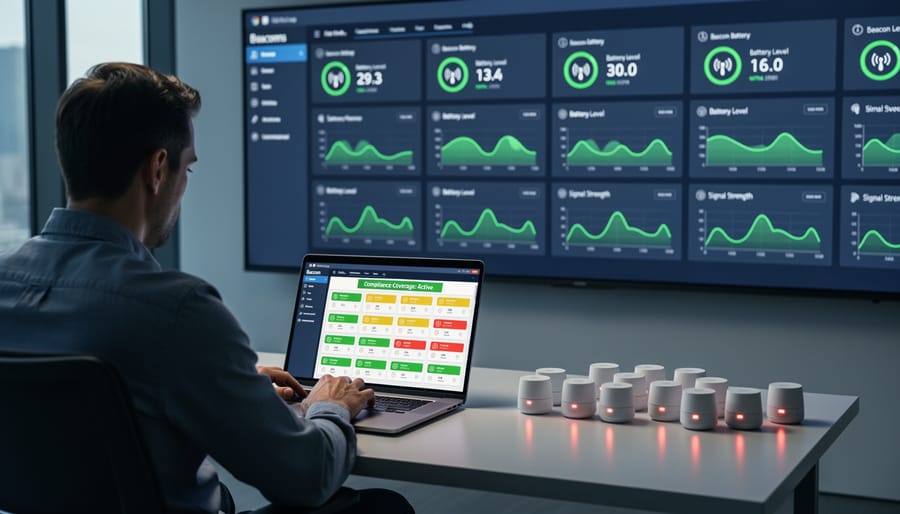
Start by implementing a monitoring system that tracks each beacon’s status in real-time. Simple cloud-based platforms can alert you when a beacon goes offline or shows weak signal strength. Many DIY enthusiasts find success using open-source solutions like Home Assistant or custom dashboards built with Node-RED, which offer flexibility without breaking the bank.
Battery management deserves special attention. Most BLE beacons run on coin cell batteries lasting 1-3 years depending on broadcast settings. Create a replacement schedule based on your deployment – mark installation dates clearly and set calendar reminders six months before expected battery death. Pro tip: buy batteries in bulk from reputable suppliers to save costs and ensure you always have spares on hand.
Firmware updates keep your beacons secure and compliant with evolving regulations. Check manufacturer websites monthly for new releases, and test updates on a few beacons before rolling out network-wide changes. This staged approach prevents widespread issues if something goes wrong.
Document everything in a maintenance log: beacon locations, installation dates, battery changes, and firmware versions. This record proves invaluable during compliance audits and helps identify patterns if problems arise.
Consider forming or joining online communities where operators share experiences and troubleshooting tips. Collaborative problem-solving often leads to creative solutions that benefit everyone working toward the same compliance goals.
Cost Analysis: Budgeting Your Compliance Solution
Understanding the financial investment required for BLE beacon geofencing helps you make informed decisions while staying compliant with Brazilian betting regulations. Let’s break down the real costs you’ll encounter when building your compliance solution.
Starting with hardware, BLE beacons are surprisingly affordable. Basic beacons suitable for geofencing range from $5 to $25 per unit depending on battery life and range capabilities. For a typical betting establishment, you’ll need 3-8 beacons to ensure reliable coverage, bringing your initial hardware investment to roughly $100-200. Consider higher-quality models with 2-3 year battery life to minimize maintenance visits.
Development expenses vary based on your approach. If you’re taking the DIY route with open-source frameworks, expect to invest 40-80 hours of development time for a functional prototype. This includes mobile app integration, backend verification systems, and testing. Hiring external developers typically costs $3,000-8,000 for a complete solution. However, community resources and existing libraries can significantly reduce these expenses, especially for teams comfortable with IoT development.
Ongoing maintenance represents the most predictable expense. Budget approximately $30-50 monthly for cloud services handling verification requests and data storage. Battery replacements occur every 1-3 years depending on beacon quality and configuration, adding minimal annual costs. Factor in occasional beacon replacements due to physical damage or environmental factors at roughly $50-100 yearly.
Now consider the alternative: regulatory penalties for non-compliance can reach hundreds of thousands of reais, potentially including operational suspensions. A complete BLE beacon geofencing system typically pays for itself if it prevents even a single compliance violation. The initial investment of $3,500-8,500 becomes remarkably cost-effective when weighed against regulatory risks and potential revenue loss from forced closures.
For budget-conscious operators, phased implementation offers breathing room. Start with a pilot deployment in one location, validate effectiveness, then scale gradually as resources allow.
BLE beacon geofencing represents a game-changing approach for Brazilian betting operators navigating the complexities of location-based compliance. By leveraging affordable, accessible technology, operators can accurately verify player locations while creating seamless user experiences that keep customers engaged and satisfied. This solution addresses regulatory requirements head-on, eliminating guesswork and reducing compliance risks through precise, real-time location verification.
The beauty of this approach lies in its accessibility. Whether you’re a seasoned developer or just beginning your journey with connected devices, implementing BLE beacon systems doesn’t require massive infrastructure investments or specialized expertise. The DIY-friendly nature of IoT solutions means smaller operators can compete with industry giants, leveling the playing field while maintaining regulatory standards.
Ready to get started? Begin by joining IoT communities where developers share beacon implementation experiences, troubleshooting tips, and code libraries. Platforms like GitHub host numerous open-source BLE projects specifically designed for geofencing applications. Consider starting with a small-scale pilot deployment at a single venue to test your setup before expanding operations.
The regulatory landscape will continue evolving, but operators who embrace beacon technology today position themselves ahead of compliance curves. Connect with fellow betting operators, share your implementation experiences, and contribute to the growing knowledge base around location verification solutions. Your next step is simple: acquire a few BLE beacons, download development tools, and start experimenting. The community is here to support your compliance journey.